
Newsletter February 2026
Dear friends of Goloka Dhama,
It is a great honour for me to write something for the February issue of the Goloka Dhama newsletter. Goloka Dhama is a very special place, and by Krishna's mercy, I have been allowed to live in this holy place for thirty years now.


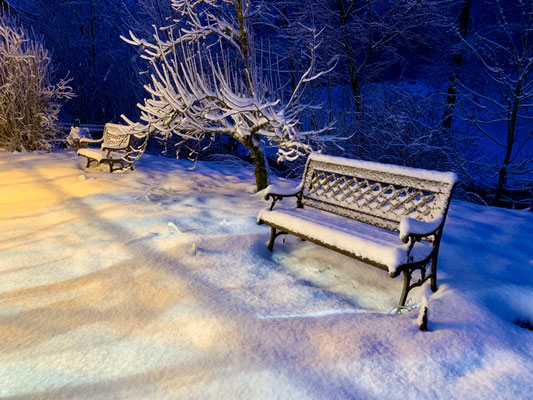
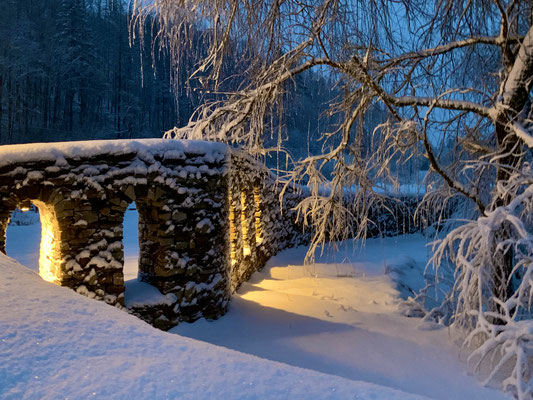
The significance of Goloka Dhama and Vrindavana
“Dhama” means divine, radiant realm where God is present, and “Goloka” is the place (loka) of cows (Go). There are various names for special spiritual places where Sri Krishna and his devotees are present. Five thousand years ago, Krishna personally appeared on this earth in the place called Vrindavana. Vana means forest, and Vrinda is the sacred Tulasi plant.
The commentary on Bhagavad-Gita 15.6 states: Here the spiritual world, the realm of the Supreme Personality of Godhead, known as Krishnaloka or Goloka Vrindavana, is described. In the spiritual heaven, neither sunshine, moonlight, fire, nor electricity are necessary, because all the planets there are self-luminous.
However, our Goloka Dhama is located in the middle of the Black Forest, as it is called here, on planet Earth. Originally, beech trees (which were sacred to the ancient Celts), oaks, birches, and alders grew in this forest, which are now slowly coming back to life and displacing the spruce trees that were planted as timber in monocultures. Since 2015, the area has been declared a national park. This means that no more trees will be cut down and hunting has been severely restricted – and will probably be completely banned in the future.
The preservation of creation represents the mode of goodness (Sattva Guna), and Shri Vishnu is responsible for the preservation of the world. Therefore, this ecological development fits very nicely with our Goloka Dhama Temple!
Although Radha and Krishna love the forest of the Tulasi shrub very much, there are also many other shrubs and trees growing in Vrindavana, all of which are very special souls. Nevertheless, our pujaris (priestesses) have always taken very devoted care of Krishna's Tulasi plants here in Goloka Dhama, and so for two years now there has been a greenhouse with beautiful large Tulasi plants! Now all that's missing are a few cows, and then everything would be there: Vrinda (Vana) and Go (Loka). Cows are wonderful creatures, but caring for them is a big responsibility. You need a lot of pasture land and, especially in our climate, adequate housing and care. At the moment, this would not be possible in Goloka Dhama, but who knows what the future may bring.
Goloka Dhama – then, now, and in the future
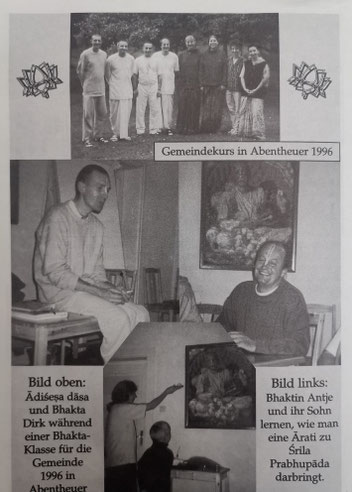
Goloka Dhama has gone through various stages of development, and I can say one thing:
“It's always moving forward!” Yes, in my opinion, it's even getting better and better!
Shri Shri Radha Madana Mohana have been in Germany for 50 years. They have been worshipped in Goloka Dhama for almost 30 years now. The divine couple are becoming more and more beautiful and the sandeshes taste better and better! The altar is also beautifully decorated these days. Why shouldn't this worship continue for decades or centuries or even millennia to come? It would be wonderful if Goloka Dhama could be preserved for many generations after us.
When we launched the Goloka Dhama project in 1995, this place still had no temple room and no Shri Shri Radha Madana Mohana. The current temple room was still a workshop used by our predecessors at that time. There was only a temporary temple room, which is now Mataji ashrama, with the Gaura Nitai Deities from the former bus program of Gadadhara and Tattva Prabhus. There were a large number of sankirtana devotees, or devotees of God, who travel from city to city during the week with the so-called sankitan vans to offer Shrila Prabhupada's books to people. The temple was a sankirtana centre for the book distributors and a place for the housekeepers to lead a spiritual family life in a natural environment. For this reason, the book warehouse in the neighboring town of Brücken was also acquired. The Bhakti Yoga introductory courses (then still under the name Bhakti Program) also took place in Goloka Dhama until the end of the 1990s. Jobs for the housekeepers were miraculously created through the founding of Vishvadeva Prabhu's company Govinda. From here, prasadam (sacred food) was distributed to millions of people.
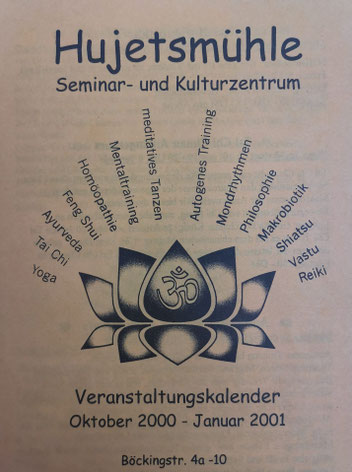
At the beginning of 2000, the project developed in a “we are open to everything” direction. On our seminar brochure, Goloka Dhama simply became Hujetsmühle Seminar and Cultural Center. Among other things, Tai Chi, Feng Shui, autogenic training, macrobiotics, and Reiki were offered. However, this phase did not last long, and we soon returned to our own spiritual roots. We realized that our own tradition actually has much more to offer and is so attractive in a transcendental way that it would be better to offer people the things that we naturally already practice ourselves. These include, in particular, the Vaishnava festivals, from Govardhana Puja to Janmashtami, which bring people from near and far to Goloka Dhama.
His Holiness Sacinandana Swami, in particular, has given many visitors and devotees deep inspiration for their spiritual lives through his transcendental lectures and his pure devotion to Shri Shri Radha Madana Mohana. His devoted disciples, such as Bhagavat Dharma dasa, Gaura Hari dasa, Vaijajanti dasi, Bhaktin Valentina, and many other devotees, have also contributed in a wonderful way to making our Goloka Dhama festivals popular with guests from all over the world. Wonderful additions to Goloka Dhama, which bless us with guests from all over the world, are also the EU-funded Erasmus and Work Away programs. (One could write an entire newsletter about this.)
Today, Goloka Dhama is what it should be: a holy pilgrimage site and a place for transcendental education. In 2025, there were a variety of spiritual seminars, beautifully organized by Divya Nama, as well as large and small festivals, all of which were well attended. This includes, of course, our Sunday festival, which has attracted many visitors over the years.
A special enrichment in Goloka Dhama are the evening kirtans, which are held very regularly by Bala Govinda and Priya Manjari to bring together many devotees and visitors every Friday evening to worship Shri Shri Radha Madana Mohana.
Shrila Prabhupada often referred to ISKCON as the Hare Krishna movement. Without movement, things get boring. When there is movement, everything remains interesting and exciting. In fact, ISKCON moves many things in the world, and many things also move within ISKCON. Movement keeps us healthy and vital, both materially and spiritually. “A rolling stone gathers no moss.” So let us all participate in and contribute to this wonderful Hare Krishna movement, each in our own way.
„Just take up this movement with patience, diligence, and intelligence. It's very easy. You've already experienced it. Don't stop. Grow more and more. Your country will be happy, and the whole world will rejoice!“
(Shrila Prabhupada, lecture in Chicago, July 10, 1975)
Hare Krishna
Your servant, Adisesa dasa, for and on behalf of Goloka Dhama